
You use AI dozens of times a day. Most of the time, you don't even notice.
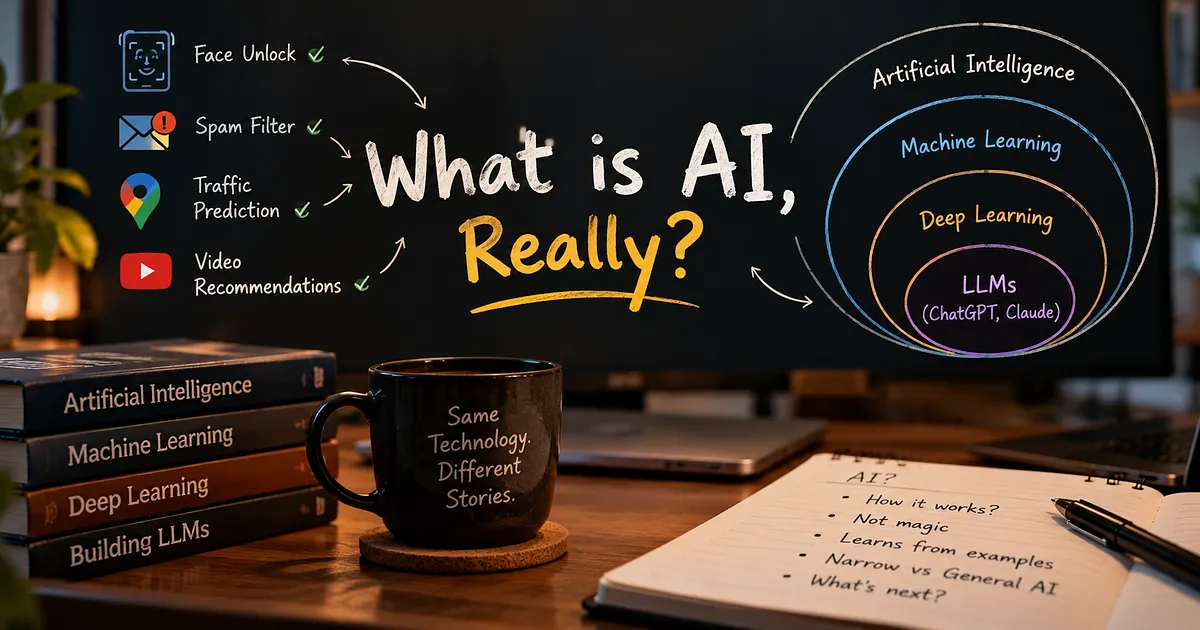
This morning your phone unlocked the moment it saw your face. Gmail quietly moved a "You won ₹10 lakh!" email into spam. Google Maps warned you the road to the office was jammed. YouTube already knew which video you'd click next.
All of this is AI. And none of it is a robot thinking about you.
That's the strange part. When people hear "AI", they picture a movie robot or a digital brain. The real thing is much simpler, and much more interesting.
In this first post of Inside AI, we'll answer one question in plain language:
What is AI, really, and how is it different from normal software?
No maths. No code. Just ideas you can explain to a friend over chai.
Normal software follows rules. AI finds them.#
To understand AI, start with how normal software works.
Imagine you're building a spam filter the traditional way. You sit down and write rules:
if email contains "you won" → spam
if email contains "free money" → spam
if sender is unknown and has a link → spam
This works, for a while. Then spammers write "y0u w0n" or "fr33 m0ney", and your rules miss them. So you add more rules. And more. Soon you have thousands of rules, and they still miss new tricks.
The problem is simple: a human has to think of every rule in advance.
Now try a different approach. Instead of writing rules, you collect 100,000 emails that people have already marked as "spam" or "not spam". You give them to the computer and say:
"Here are examples. Figure out the pattern yourself."
The computer studies them and notices things no human listed: certain words, odd punctuation, suspicious links, strange sending times. It builds its own rules from the examples.
That is the core idea of AI:
Normal software | AI | |
|---|---|---|
Who makes the rules? | A programmer writes them | The computer learns them from examples |
What you give it | Rules + data | Examples + answers |
Handles new tricks? | Only if someone adds a rule | Often, if they look like the examples |
Good for | Clear, fixed logic (tax maths, billing) | Fuzzy patterns (faces, language, spam) |
In one sentence: AI is software that learns patterns from examples instead of following rules a human wrote.
Notice what this means. AI isn't magic, and it isn't thinking the way you do. It's a very good pattern-finder.
AI, Machine Learning, Deep Learning, LLMs: what's the difference?#
You've heard all these words, often used as if they mean the same thing. They don't. Think of them as circles inside circles, like Russian nesting dolls:
┌─────────────────────────────────────────┐
│ Artificial Intelligence                 │
│  ┌───────────────────────────────────┐  │
│  │ Machine Learning                  │  │
│  │  ┌─────────────────────────────┐  │  │
│  │  │ Deep Learning               │  │  │
│  │  │  ┌───────────────────────┐  │  │  │
│  │  │  │ LLMs (ChatGPT, Claude)│  │  │  │
│  │  │  └───────────────────────┘  │  │  │
│  │  └─────────────────────────────┘  │  │
│  └───────────────────────────────────┘  │
└─────────────────────────────────────────┘
Let's open each doll.
1. Artificial Intelligence (the biggest circle) Any technique that makes a computer do something we'd normally call "intelligent": recognising a face, playing chess, understanding speech. It's the umbrella word. Even old rule-based chess programs count.
2. Machine Learning (inside AI) The part of AI where computers learn from examples instead of following hand-written rules. Our spam filter lives here. So do Netflix recommendations and bank fraud alerts.
3. Deep Learning (inside Machine Learning) A powerful kind of machine learning that uses neural networks with many layers. It's behind face unlock, voice assistants and self-driving research. We'll open this up properly in #003.
4. Large Language Models, or LLMs (inside Deep Learning) Deep learning models trained on enormous amounts of text to understand and write language. ChatGPT, Claude and Gemini are LLMs. They're the reason AI suddenly feels everywhere since 2022. We'll meet them in #004.
Quick memory trick: every LLM is deep learning, every deep learning model is machine learning, and all of it is AI. But not all AI is an LLM.
Narrow AI vs General AI#
There's one more distinction that clears up a lot of confusion.
Narrow AI is built for one kind of task. The spam filter can't recognise faces. The face-unlock model can't recommend videos. Each is excellent at its one job and useless outside it. Every AI that exists today is narrow AI, even ChatGPT. It's very broad within language, but it can't learn to ride a bicycle or truly understand the world the way you do.
General AI (often called AGI) would be a system that can learn and do any intellectual task a human can, and transfer what it learns from one area to another. This doesn't exist yet. Researchers disagree, sometimes strongly, on when or whether it will.
So when a headline says "AI is taking over", it's usually talking about narrow AI getting better at specific tasks.
Three common myths#
Myth 1: "AI thinks like a human." It doesn't. It finds statistical patterns in data. It has no feelings, intentions or understanding in the human sense, even when it sounds friendly.
Myth 2: "AI is always right." AI learns from examples, so it's only as good as those examples. Biased or incomplete data produces biased or wrong answers. We'll see why chatbots sometimes invent facts in #010.
Myth 3: "AI is brand new." The term was coined in 1956. What's new is the combination of huge amounts of data, cheap powerful computers (especially GPUs) and better techniques. That's why AI exploded in the last decade.
Beneath the surface#
Here's something that surprises most people: a trained AI model is just a file full of numbers.
No rules. No sentences. No "if spam then…". Just millions (or billions) of numbers. When the model "learns", all that really happens is those numbers get adjusted, again and again, until the model's guesses match the examples.
Face unlock, Netflix, ChatGPT: under the hood, each one is a big pile of carefully tuned numbers. How those numbers get tuned is exactly what we'll explore next.
Recap#
AI is software that learns patterns from examples instead of following hand-written rules.
AI ⊃ Machine Learning ⊃ Deep Learning ⊃ LLMs: each is a smaller, more specific circle inside the last.
All AI today is narrow: brilliant at specific tasks, but not thinking like a human.
Coming up next#
Inside AI #002: How Does a Machine Learn? We'll follow our spam filter step by step, from a pile of emails to a trained model, and see what "training" actually means.
If this helped, subscribe to the newsletter so you don't miss the next part of the series.