
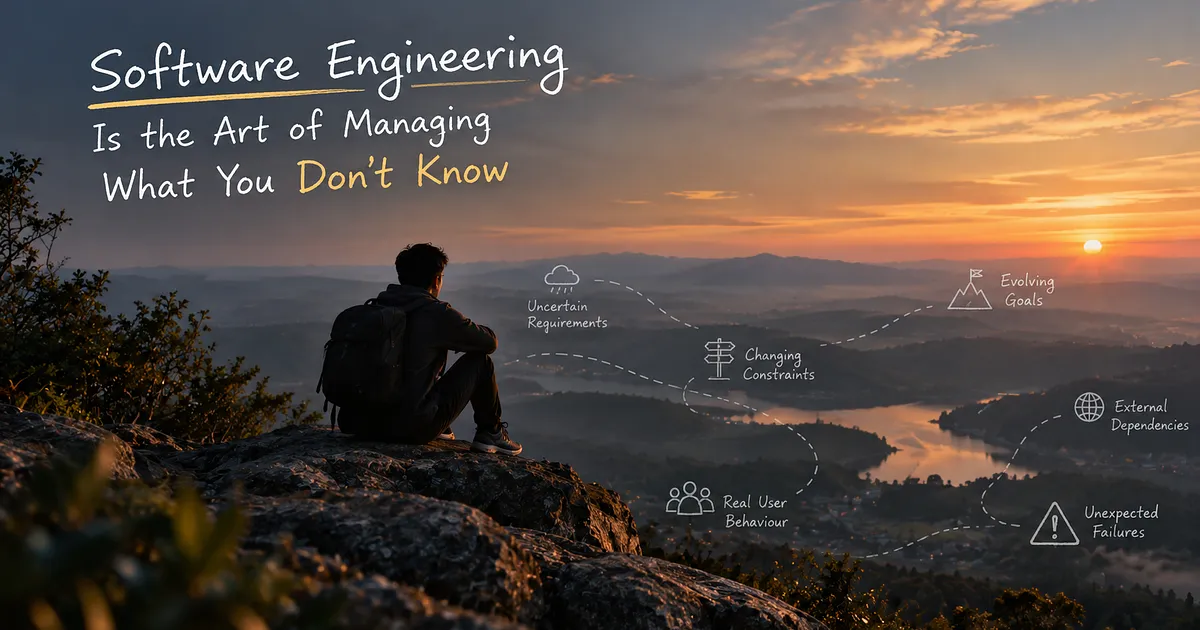
🚀 The biggest failures don't always come from bad code. Sometimes, they come from things nobody thought to question.
Imagine this. 👇
Your feature is ready. ✅
All tests are passing. 🧪
The code review is complete. 👨💻
The deployment is successful. 🚀
Everything looks perfect.
Until... 💥
Two customers book the same seat. A payment succeeds, but the confirmation never arrives. An external service stops responding, and suddenly your entire application is struggling.
The code looked correct. So what went wrong?
Perhaps the system did exactly what you told it to do—but not what you expected it to do.
Welcome to one of the most fascinating truths about software engineering:
You can build everything according to plan and still get a result you never planned for.
🔍 01. The Most Dangerous Words in Engineering?#
"That should never happen."
We've all encountered assumptions like these:
🤞 "Users won't click that button twice."
🌐 "The network will always respond."
📦 "This dependency won't break."
📈 "Our current design will scale just fine."
✅ "It worked perfectly in testing!"
These assumptions might seem reasonable. Until reality challenges them.
Consider an online store. A customer pays for an order, but their internet connection drops before the confirmation appears. Unsure whether the payment succeeded, they click Pay again.
If the system isn't designed to handle repeated requests safely, the customer might be charged twice.
The problem isn't necessarily bad payment logic. It's an overlooked possibility: a successful operation doesn't guarantee that its response reaches the user.
And that's the tricky part. Sometimes, the most expensive bugs begin with something nobody thought was worth questioning.
🌪️ 02. You Can't Predict Everything. And That's Okay.#
When we discover these possibilities, our first instinct might be to prepare for every scenario.
Every edge case. Every failure. Every possible future requirement.
But here's the catch. 👀
You can spend months preparing for problems that never occur while making the actual system unnecessarily complicated.
Good engineering isn't about eliminating every unknown. It's about knowing which unknowns deserve your attention.
Ask yourself three questions:
🎯 What could go wrong?
⚠️ How much would it matter?
🛠️ How would we recover?
A temporary glitch on a profile page isn't the same as losing customer data or processing a payment twice.
Different risks require different levels of protection.
The goal isn't to build a system that can survive every imaginable disaster.
It's to build one that handles realistic risks intelligently—and doesn't collapse when something unexpected happens.
💡 03. Great Engineers Don't Just Find Answers. They Challenge Questions.#
Imagine two engineers approaching an unfamiliar problem.
👨💻 Engineer A immediately starts coding. They have a solution in mind and want to implement it.
🧠 Engineer B pauses and asks:
Do we actually understand the problem?
Which assumptions are we making?
What evidence would prove us wrong?
Can we test the riskiest part before building everything?
Both might eventually produce the same solution.
But Engineer B has done something valuable: reduced uncertainty before committing significant time and effort.
Sometimes, a small experiment can save weeks of development. One conversation with a user can invalidate an entire feature idea. One measurement can reveal that the bottleneck everyone was discussing isn't the real problem.
🔥 The smartest next step isn't always writing more code. Sometimes, it's discovering whether you're solving the right problem.
🛡️ 04. Build Systems That Expect the Unexpected#
We can't predict every failure. But we can decide how our systems respond when things go wrong.
Think about it:
🔁 Safe retries help prevent repeated requests from causing duplicate operations.
📊 Monitoring helps us discover problems before they become mysteries.
💾 Tested backups give us a recovery path when data is lost.
🧪 Small experiments help validate assumptions before major investments.
🔄 Reversible decisions make it easier to adapt when requirements change.
Notice the pattern?
None of these practices guarantees that something will never fail.
They make failure easier to detect, contain, understand, or recover from.
That's a fundamentally different way of thinking about reliability.
A reliable system isn't one where nothing ever goes wrong. It's one designed with a plan for when something does.
🧩 05. The Real Difference Between Experience and Expertise#
Experience doesn't magically remove uncertainty.
Experienced engineers still encounter strange bugs. Requirements still change. Systems still behave in unexpected ways.
What changes is their relationship with the unknown.
They become more comfortable saying, "We don't know yet."
They learn to question assumptions before turning them into permanent design decisions. They recognize when to investigate, when to experiment, and when a simple solution is better than an elaborate one.
They understand that confidence and certainty aren't the same thing.
And perhaps most importantly, they know that being wrong isn't always the biggest problem.
Failing to recognize that you might be wrong is often much more dangerous.
🚀 The Takeaway: Engineer for Reality, Not Just the Plan#
The next time something breaks unexpectedly, don't stop at asking:
"Which line of code caused this?"
Go one level deeper. 🔎
"What did we believe about this system that turned out not to be true?"
Maybe you misunderstood how users behave. Maybe two operations happened simultaneously. Maybe a dependency failed in a way you hadn't considered.
Finding the immediate bug fixes today's problem.
Understanding the assumption behind it might prevent tomorrow's.
And that's where engineering becomes more than implementation. It becomes a discipline of questioning, learning, adapting, and making better decisions with incomplete information.
We will never know everything about the systems we build. The world is too unpredictable, requirements are too fluid, and complexity is too interconnected.
But we can become better at recognizing what we don't know—and designing accordingly.
Because ultimately...
🧠 Software engineering isn't the art of knowing everything.
⚡ It's the art of making good decisions when you don't.
✍️ Notes from beneath the surface — Exploring the ideas, decisions, and hidden complexities behind the software we build.